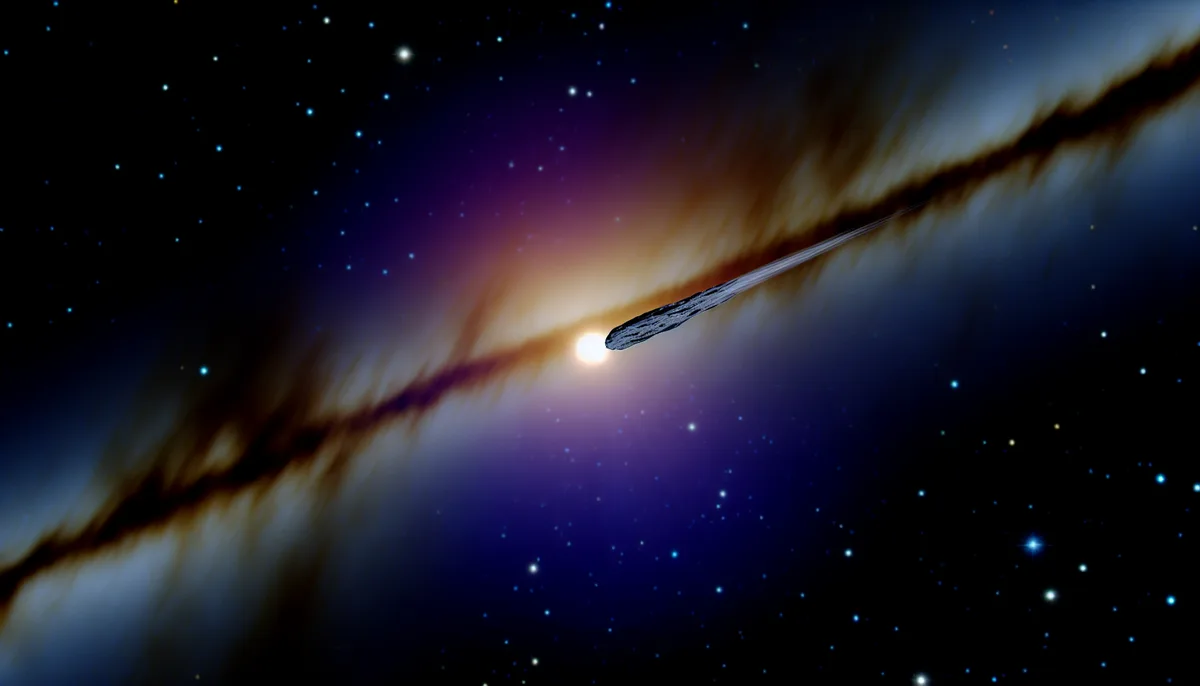
In the infinite expanse of the universe, one object has continuously captured our collective curiosity: Tabby’s Star. It’s an intriguing celestial body that has captured the imagination of both the scientific community and star-gazers alike. So, what’s the big deal about this little blink in the vast darkness of space? As an astronomy enthusiast myself, I am thrilled to delve into the enigmatic mysteries surrounding the star formally known as KIC 8462852, but affectionately referred to as Tabby’s Star.
Discovering Tabby’s Star
First things first, why the name Tabby’s Star? The moniker was given in honor of astronomer Tabetha S. Boyajian, who led a team of scientists that discovered this enigma in 2015. However, the star itself is not new. It’s a giant old star that is 50% larger and 1000 degrees hotter than our sun, located around 1,480 light years away from us in the Cygnus constellation. But its peculiar light patterns have puzzled scientists for years.
The Mysterious Behaviour of Tabby’s Star
The intrigue surrounding Tabby’s Star isn’t so much about what it is, but what it does. Stars typically have a consistent light pattern, but not this one! Instead, the brightness of Tabby’s Star shows significant irregular dips over time, dropping by more than 20% on occasions. This tendency to dim and brighten in an unpredictable manner is truly unusual compared to other stars.
Alien Megastructures?
Now, that’s where things get interesting. When trying to explain these light fluctuations, some theories suggested the presence of alien megastructures like Dyson Spheres, attempting to harvest energy from the star. You might have heard of this on the sci-fi channel, but it’s a concept worth considering. Although for now, the evidence for this is absent, the idea nonetheless sparked an abundance of enthusiasm amongst space enthusiasts and stargazers around the globe, myself included.
However, according to American Association of Variable Star Observers (AAVSO), dust accumulation could be causing the irregular light patterns from Tabby’s Star. But the mystery isn’t entirely solved yet.
Demystifying Tabby’s Star
While alien megastructures make for fascinating conjecture, scientists prefer to base their findings on tangible data. Over the past few years, there have been extensive studies, research, and speculations on the fluctuations observed in the light emitted by Tabby’s Star.
Natural Phenomena?
Recent studies suggest that a dust cloud or a swarm of comets might be causative of this star’s unusual behavior. On observing the star more closely using the Spitzer and Swift missions, and the Belgian AstroLAB IRIS observatory, scientists found that the dimming of the star was more intense in ultraviolet light. This confirmed the theory that the occluding objects were not opaque, as one would require for an alien megastructure, but translucent — just like dust!
Unending Observations and Studies
Despite the breakthroughs, the mystery of Tabby’s Star remains unknown. Ongoing research and constant monitoring continue to bring forth more data to further understand this unique formation. The thrill surrounding Tabby’s Star is a testament to our collective appetite for exploring and understanding the mysteries of the universe.
In conclusion, our universe is dotted with countless stars, and each one tells a unique tale. While we’ve been able to unravel the stories of many of these shining wonders, some, like Tabby’s Star, still keep us on the edge of our telescopic lenses, anticipating what it might reveal next. As a fellow stargazer, I can’t wait to see what it’ll be. Until then, keep looking up. The stars have a lot to say.